Overhead Doors 101: different types, benefits, and their role in physical security

How overhead doors protect facilities while optimizing workflows and how to choose the right one.
Table of Contents:
Introduction
Overhead doors are one of the most common, and most overlooked, components of physical security at commercial and industrial facilities. From loading docks and airport hangars to self-storage buildings and cold-chain warehouses, they serve as the first line of defense against unauthorized access, environmental exposure, and operational inefficiency.
But not all overhead doors are created equal. Choosing the wrong type, skipping integration with broader security systems, or neglecting maintenance can leave gaps that compromise both safety and ROI.
This guide breaks down the major types of overhead doors, the measurable benefits they deliver, the compliance standards they need to meet, and a practical framework for selecting the right solution for your facility.
Overhead Doors Role in Physical Security
At their core, overhead doors function as controlled-access barriers. They restrict entry to authorized personnel and vehicles, protect inventory and equipment from theft and vandalism, and help compartmentalize sensitive areas within a facility.
According to the FBI's Uniform Crime Report, commercial burglary and theft consistently rank among the costliest property crimes in the U.S., with businesses losing billions annually. For facilities that handle high-value inventory, raw materials, or sensitive operations, a properly secured entry point isn't optional, it's foundational.
Overhead doors become especially effective when they operate within a broader security ecosystem rather than in isolation. When integrated with dock levelers, access control platforms, and intrusion detection systems, they shift from passive barriers to active components of a facility's security, automatically responding to credentials, triggering alerts on unauthorized activity, and logging access events for audit purposes.
However, not every facility faces the same threats or operational demands. That's where the differences between overhead door types become critical.
Types of Overhead Doors and Where They're Used

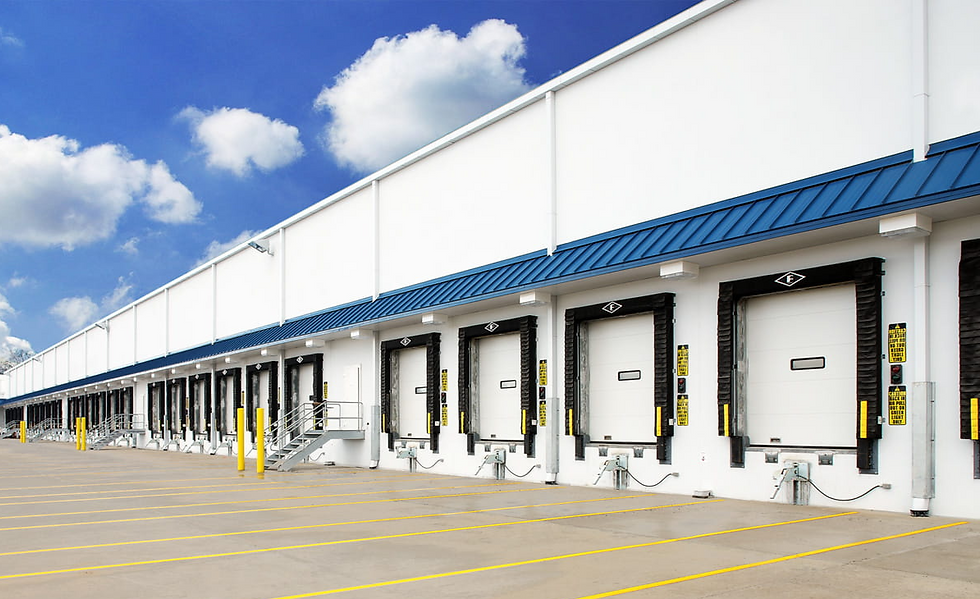
Dock Doors
Dock doors are purpose-built for loading bays and docking stations where freight moves in and out of a facility. They're constructed from heavy-gauge steel or reinforced aluminum to withstand repeated impact from forklifts, pallets, and trailer contact.
Best suited for: Distribution centers, manufacturing plants, retail fulfillment hubs, and any facility with regular freight traffic.
Key features:
Reinforced panel construction to resist forced entry and daily wear
Insulated options for temperature-sensitive environments (cold storage, food and beverage)
Compatibility with dock seals and shelters to minimize energy loss during loading

High-Speed Doors
High-speed overhead doors are engineered for environments where cycle time matters. Most high-speed models can complete a full open-close cycle in roughly 2 to 5 seconds, compared to 20 to 30 seconds for a standard sectional door, which significantly reduces the time a facility opening is exposed and vulnerable.
Best suited for: High-traffic warehouses, clean rooms, pharmaceutical facilities, automotive plants, and cold-chain operations where maintaining internal conditions is critical.
Key features:
Rapid operation to reduce air exchange, energy loss, and contamination risk
Durable curtain materials (PVC, rubber, or composite) rated for tens of thousands of cycles
Built-in safety sensors and breakaway designs to prevent accidents in busy environments

Fire-Rated Doors
Fire-rated overhead doors are engineered to compartmentalize fire and smoke, slowing the spread of damage and providing occupants time to evacuate. They are rated by the duration they can withstand fire exposure, typically ranging from 1 to 4 hours, and must meet strict testing and certification standards.
Best suited for: Any facility required to comply with fire separation codes — including manufacturing plants, chemical storage areas, parking structures, and multi-tenant commercial buildings.
Key features:
Available in rolling steel, sectional, and coiling designs in both manual and automatic operation
Integrated fusible links or electronic release mechanisms that activate during a fire event
Tested and labeled to UL 10B, UL 10C, or NFPA 252 standards (more on compliance below)

Hangar Doors
Hangar doors are among the largest overhead door systems available, custom-built to accommodate aircraft, heavy equipment, and oversized vehicles. They come in bi-fold, hydraulic, sliding, and high-speed configurations depending on the application.
Best suited for: Airports, military installations, shipyards, large-scale storage warehouses, and industrial maintenance facilities.
Key features:
Spans that can exceed 200 feet depending on the configuration
Wind-load ratings engineered for harsh and coastal environments
Heavy-duty construction rated for continuous, high-frequency operation

Dock Levelers (Supporting Equipment)
While not technically an overhead door, dock levelers are essential companion equipment at any facility with loading bays. They bridge the gap between the dock floor and the trailer bed, adjusting hydraulically, mechanically, or pneumatically to match varying vehicle heights.
Why they matter for security and safety: An unstable or poorly maintained leveler creates fall hazards, slows operations, and can damage freight. According to OSHA, falls from loading docks are one of the most common causes of workplace injury in warehouse environments. Properly integrated levelers reduce accident risk and keep throughput consistent.
Benefits of Overhead Doors
Strengthened Security
Overhead doors constructed from heavy-gauge steel, reinforced aluminum, or impact-resistant composites are difficult to breach through brute force. Modern designs can incorporate advanced locking mechanisms, biometric readers, and integration with electronic access control, turning a physical barrier into an actively managed access point.
High-speed doors add another layer of security by minimizing the window of time an opening is exposed. A door that closes in 3 seconds gives an unauthorized individual far less opportunity to enter than one that takes 25 seconds.
Improved Operational Efficiency
Faster door cycles translate directly to throughput gains. In a busy distribution center, shaving 15 to 20 seconds off each door cycle across dozens of daily openings can recover significant productive time and reduce vehicle idle time at loading bays. This means quicker delivery truck turnaround, fewer bottlenecks during peak hours, and smoother coordination between inbound and outbound logistics.
Energy Savings and Climate Control
Insulated overhead doors help facilities maintain stable interior temperatures, which is especially critical in cold storage, food processing, and pharmaceutical environments. Every second a door remains open, conditioned air escapes and outside air enters, driving up HVAC costs and risking product quality.
High-speed doors compound this advantage. Industry estimates suggest that high-speed insulated doors can reduce air exchange by up to 80% compared to standard sectional doors, contributing to measurable reductions in heating and cooling costs. Facilities also gain better control over indoor humidity, helping prevent frost and ice accumulation that can damage products or create slip hazards.
Reduced Risk and Liability
Safety features like photoelectric sensors, motion detectors, and breakaway curtain designs help prevent collisions and crush injuries, a serious concern in environments with forklift traffic, pedestrians, and large vehicles operating in proximity. Fewer incidents mean lower workers' compensation costs, less operational downtime, and reduced liability exposure.
Compliance and Industry Standards
Overhead doors aren't just a security investment; they're often a regulatory requirement. Facilities should be aware of the following standards and codes when specifying, installing, and maintaining overhead doors:
NFPA 80 (Standard for Fire Doors and Other Opening Protectives): Governs the installation, inspection, testing, and maintenance of fire-rated door assemblies. Requires annual inspections and documentation.
NFPA 252 / UL 10B / UL 10C: Testing standards that determine the fire-resistance rating of door assemblies. Fire-rated doors must carry a label from an accredited testing laboratory.
OSHA (Occupational Safety and Health Administration): Requires employers to maintain safe loading dock environments, including proper dock leveler operation, fall protection, and door safety mechanisms.
International Building Code (IBC): Specifies fire separation requirements between occupancies and dictates where fire-rated doors must be installed based on building type and use.
Local fire codes and AHJ requirements: Authority Having Jurisdiction (AHJ) requirements vary by municipality and can impose additional obligations beyond national standards.
Working with an installer or integrator familiar with these codes is essential to avoiding compliance gaps, failed inspections, and potential liability.
Maintenance and Lifecycle Considerations
Overhead doors are long-term infrastructure investments, and their performance depends heavily on how well they're maintained. Neglected doors degrade in both security effectiveness and operational reliability and can become safety hazards.
Recommended Maintenance Practices
Routine inspections: Industry best practice calls for at least annual professional inspections of all overhead door systems. NFPA 80 specifically mandates annual inspections for fire-rated doors, with documentation kept on file.
Lubrication and hardware checks: Tracks, rollers, hinges, springs, and seals should be inspected and lubricated on a regular schedule (quarterly is common for high-traffic doors) to prevent premature wear and failure.
Safety system testing: Photoelectric sensors, auto-reverse mechanisms, and breakaway features should be tested regularly to confirm they're functioning correctly.
Weather seal and insulation checks: Damaged seals reduce energy efficiency and can allow water, pests, and contaminants into the facility.
Expected Lifespan
The lifespan of an overhead door depends on the type, material, usage frequency, and maintenance regimen. As a general benchmark, standard commercial sectional doors typically last 15 to 30 years with proper maintenance. High-speed doors, due to their more intensive cycle counts, may require curtain or panel replacement sooner, though the motor and frame assemblies are built for long-term service. Fire-rated doors should be replaced or re-certified when they no longer meet code requirements, regardless of physical condition.
Total Cost of Ownership
When evaluating overhead doors, the purchase price is only part of the equation. Facilities should factor in installation costs, energy savings over time, maintenance and inspection expenses, potential downtime from failures, and the cost of compliance-related upgrades. A higher-quality, professionally installed door often delivers a lower total cost of ownership over its service life compared to a cheaper alternative that requires frequent repairs.
How to Choose the Right Overhead Door for Your Facility
With multiple door types and a wide range of features available, selecting the right overhead door comes down to matching the solution to the facility's specific operational demands, threat profile, and regulatory obligations.
Factor | Questions to Ask | Door Types to Consider |
Facility type | Is this a warehouse, airport, clean room, cold storage, or multi-tenant building? | Dock doors, hangar doors, high-speed doors |
Traffic volume | How many open-close cycles per day? Are there heavy vehicle and pedestrian traffic? | High-speed doors for high-cycle environments |
Security threat level | What's the value of assets inside? Is the facility in a high-crime area? Are there sensitive operations? | Reinforced dock doors, biometric-integrated doors |
Environmental control | Does the facility require strict temperature, humidity, or contamination control? | Insulated doors, high-speed doors |
Fire code requirements | Does the building require fire-rated separations between zones or occupancies? | Fire-rated rolling or sectional doors |
Size and clearance | Are openings oversized for aircraft, large equipment, or vessels? | Custom hangar doors |
Integration needs | Will the door need to communicate with access control, intrusion detection, or building management systems? | Any type — prioritize models with integration-ready controls |
This table is a starting point. A qualified physical security integrator can conduct a site assessment to identify specific vulnerabilities and recommend configurations tailored to the facility's needs.
Key Integration and Customization Considerations
Overhead doors deliver the most value when they're part of a connected security infrastructure rather than standalone components. The most common and effective integrations include:
Access control systems allow overhead doors to open and close automatically when authorized individuals present valid credentials, badges, PINs, biometrics, or mobile credentials. This eliminates manual operation, reduces human error, and creates a log of every access event.
Intrusion detection systems can trigger real-time alerts to security personnel when unauthorized activity is detected near overhead doors, whether it's an attempted breach, a door held open beyond a set time, or access outside of normal operating hours.
Building management systems (BMS) tie overhead door operation into broader facility controls, enabling automated scheduling, energy management, and centralized monitoring across multiple sites.
Beyond integration, custom enhancements allow facilities to address specific vulnerabilities or operational requirements. High-security environments may benefit from reinforced materials, smart locks, or redundant locking mechanisms. Facilities with non-standard opening sizes can have doors custom-built to precise measurements. And organizations with multi-site footprints can standardize door specifications across locations for consistent security posture and simplified maintenance.

Professional Installation Matters
Regardless of the door type or features selected, professional installation by a qualified integrator is strongly recommended. Improper installation can compromise security effectiveness, void manufacturer warranties, create safety hazards, and lead to compliance failures. An experienced integrator keeps the door is correctly fitted, properly connected to supporting systems, and fully tested before going operational, and can provide ongoing service and inspection support.
Conclusion
Overhead doors are a foundational element of physical security for commercial and industrial facilities. But their effectiveness depends entirely on selecting the right type for the application, integrating them within a broader security ecosystem, maintaining them to code, and working with qualified professionals for installation and service.
The right overhead door doesn't just protect a building it improves throughput, reduces energy costs, lowers liability, and helps facilities stay compliant with evolving safety standards. The wrong one creates gaps that are easy to overlook until they become expensive problems.
IronSite is a national physical security provider with specialized expertise to deliver premium solutions at scale, including tailored strategies for gated communities and residential developments. Our extensive family of brands nationwide enables responsive and consistent service and support wherever your properties are located.
Media Contact
Terin Pickett
IronSite
1595 E. 6th St; Suite 101
Corona, CA 92879


Comments