Security Fencing: Types, Costs, and Critical Factors to Consider Before Buying

Updated: Jun 12
A complete breakdown of security fence types, installation factors, compliance standards, and pricing considerations for commercial, industrial, and high-security properties.
Table of Contents:
Key Takeaways:
Security fence height ranges from 5 feet for low-security applications to 10 feet or more for maximum-security sites, with material and design driven by the required protection level.
Site conditions like soil, slope, underground utilities, and weather often have a larger impact on total cost than the fence itself.
Integrating security fencing with access control (automated gates, turnstiles, vehicle barriers, biometrics) creates layered security and can reduce insurance premiums.
ASTM standards F552, F1083, F2200, F2408, F2656, and F3296 govern structural, crash-rated, and electric security fencing requirements in the United States.
A professional security integrator is the recommended path for commercial, industrial, and high-security projects, since they coordinate site assessment, design, installation, and compliance under one scope.
What is Security Fencing?
Security fencing is a perimeter barrier engineered to deter, delay, and detect unauthorized access to a property. Unlike standard residential fencing, security fencing is rated for specific protection levels and often integrates with broader security ecosystems including automated gates, access control systems, CCTV, and alarm monitoring.
Choosing the right security fence comes down to five core factors:
Level of protection required
Site conditions and terrain
Access control integration needs
Environment and weather
Compliance and regulatory requirements
Each of these directly affects the design, material, height, installation method, and total cost of the project.
Security Fence Types by Protection Level
The level of protdection needed is the single biggest influence on fence type, height, material, and design. Security fencing is generally categorized into three tiers.
Low-Security Fencing
Best for gated communities, residential perimeters, and light commercial properties:
Typical height: 5 to 6 feet
Common materials: Solid wood, vinyl, ornamental aluminum, wrought iron
Key features: Solid privacy panels or close-spaced pickets for basic anti-climb protection
Medium-Security Fencing
Best for warehouses, industrial sites, commercial campuses, and utility yards.
Typical height: 8 feet
Common materials: Chain link, steel palisade, welded wire mesh
Key features: Anti-cut designs, deeper concrete footings, heavy-duty lockable hardware
High-Security Fencing
Best for government facilities, data centers, utilities, airports, military installations, and correctional sites.
Minimum height: 10 feet
Common materials: Security-rated steel mesh, reinforced concrete walls, crash-rated barriers
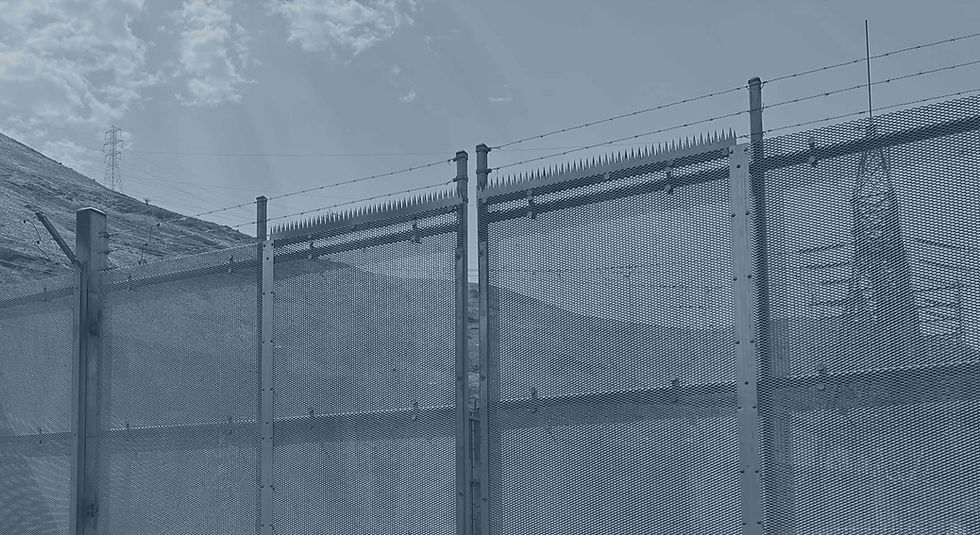
Key features: Barbed or razor wire topping, electric security elements, CCTV and alarm integration, deep structural foundations


Security Fencing Comparison Table
Protection Level | Height | Common Materials | Typical Use Case |
Low | 5 to 6 ft | Wood, vinyl, aluminum, wrought iron | Residential, gated communities |
Medium | 8 ft | Chain link, steel palisade, welded mesh | Commercial, industrial |
High | 10+ ft | Steel mesh, reinforced concrete, crash-rated | Critical infrastructure, government |
Why Access Control Integration Matters
If your property has more than one layer of security, integrating those layers should be a top priority. Security fencing is most effective when paired with access control solutions like automated gates, turnstiles, vehicle barriers, and surveillance to create a layered defense, which is a common component of the most successful security strategies.
Integrating access control with security fencing:
Eliminates human error by automating authentication through key cards, smart tokens, biometrics, or license plate recognition (LPR)
Streamlines access management and prevents unauthorized entry
Improves response times through real-time alerts to security personnel or local law enforcement
Reduces liability and insurance premiums, since many providers recognize integrated or automated access control as proactive risk management
Segmented systems create vulnerabilities. If you operate more than one security solution, consolidating them into a single integrated platform should be the goal.
Site Conditions: Excavation and Installation Factors
Site conditions often drive cost more than the fence itself. Soil type, slope, underground utilities, and on-site accessibility all influence the installation method and the final budget.
Soil Type and Excavation
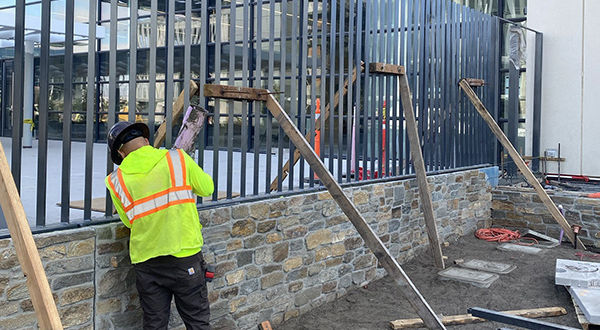
Loose, sandy, or wet soil requires wider and deeper post holes, larger concrete footings, and sometimes specialized equipment to drive posts into the ground. Hard clay or rocky soil requires heavy-duty augers, jackhammers, or specialized drilling equipment.
Slope and Terrain
Steep slopes or hills require stepped panels (a staircase-style installation) or racked panels that angle the fence to follow the contour of the ground. Uneven, rolling, or wavy terrain requires varied post heights and leveling work to keep the top line of the fence consistent.
Either situation may also require retaining walls or specialized footings, both of which add complexity and cost.
Space Restrictions and Underground Obstructions
Underground utilities like gas, water, electric, and fiber-optic must be located before excavation. In the U.S., calling 811 before digging is both standard practice and required by law in most states. Hitting a utility line is one of the costliest mistakes in fence construction.
Limited site access is equally important. If heavy machinery can't reach the perimeter, crews must hand-dig holes and mix concrete manually, which adds significant time and labor cost.
Environment and Weather Considerations
Sites with less-than-ideal weather conditions add another layer of planning to a security fencing project.
Wind Exposure
Areas with consistent strong winds, especially fences fitted with privacy screens, place significant stress on posts. These environments require closer post spacing and deeper foundations, increasing material and labor costs.
Overgrown or Wooded Sites
Dense brush and trees must be cleared before installation. Roots can damage fences over time, and overgrowth can create hiding spots that compromise the security of the perimeter.
Cold Climates
In cold regions, post footings must be installed below the local frost line to prevent frost heave. As ice expands and contracts in the soil, improperly anchored posts will loosen and shift.
Hot Climates
Metal fencing expands and contracts with temperature swings. Expansion gaps at connection points are required to prevent stress damage to joints and welds.
Compliance and Regulatory Standards
Adhering to local, state, and federal regulations protects people from harm and businesses from fines and lawsuits. Before any installation, confirm zoning rules, permit requirements, and applicable safety standards.
Key ASTM Standards for Security Fencing
Standard | What It Covers |
ASTM F552 | Standard terminology for chain-link fencing |
ASTM F1083 | Structural requirements for steel pipe used in chain-link fence framework |
ASTM F2200 | Construction standards for automated vehicular gate systems |
ASTM F2408 | Ornamental fences employing galvanized steel tubular pickets |
ASTM F2656 | Crash-rated vehicle barrier testing (anti-ram security) |
ASTM F3296 | Safe, non-lethal use of electric security fencing in commercial markets |
Compliance with these standards demonstrates due diligence and is often required by insurance carriers, government contracts, and critical infrastructure projects.
How Much Does Security Fencing Cost?
Total cost depends on dozens of variables, which is why most commercial and industrial buyers work with a professional security integrator rather than estimating the project in-house. A qualified integrator brings:
Accurate site assessment based on field experience
Expertise in matching solutions to your specific risk profile and operations
Access to multiple manufacturers, product lines, and equipment
Specialized knowledge for high-security, crash-rated, or critical infrastructure applications
What Affects Security Fence Pricing?
Scope of services. Specialized providers handling crash-rated or critical infrastructure projects cost more than basic fence contractors.
Site conditions. Soil, slope, vegetation, and machinery access can shift the budget significantly.
Material grade and certifications. ASTM-rated and crash-tested products command a premium.
Additional features. Anti-climb design, electrification, CCTV integration, and access control all add to total project cost.
Initial vs. Lifetime Costs
Initial costs include security assessment, design, installation, and training. These are typically one-time expenses and represent the largest portion of the investment.
Lifetime costs include maintenance, repairs, and operational expenses. These are smaller and recurring over the lifespan of the fence.
A reputable integrator provides transparent pricing with no hidden fees. Unforeseen site conditions can add cost, but they should be communicated up front, not buried in the final invoice.
Breakdown of Lifetime Expenses*
Type of Cost | Percentage | Cost Explanation |
Initial Acquisition | 45% | Panels, posts, hardware |
Installation | 30% | Labor, post holes, concrete footings |
Preventative Maintenance | 10% | Vegetation clearing, rust treatment |
Unscheduled Repairs | 15% | Patching breaches, fixing vehicle impact damage |
*The above table consists of the most common types of costs. Actual costs may vary based on specific project requirements, site conditions, and preferences. The percentages outlined in this table are for illustrative and estimation purposes only.
Frequently Asked Questions
How tall should a security fence be?
For most commercial and industrial properties, 8 feet is the minimum. High-security applications like government facilities, utilities, data centers, and critical infrastructure generally require 10 feet or taller, often with anti-climb toppings such as barbed or razor wire.
What is the most secure type of fencing?
Crash-rated steel mesh and reinforced concrete barriers offer the highest level of physical security. Crash ratings are governed by ASTM F2656, which tests vehicle penetration resistance for anti-ram applications.
What is the difference between security fencing and regular fencing?
Standard fencing is designed primarily for privacy, aesthetics, or basic boundary marking. Security fencing is engineered to deter, delay, and detect intrusion, using rated materials, anti-climb and anti-cut designs, structural footings, and integration with access control and surveillance systems.
Do I need a permit to install a security fence?
Most jurisdictions require permits for commercial fencing, especially for heights over 6 to 8 feet, electrified fencing, or installations in commercial zones. Always check with your local building or zoning authority before starting a project.
Can security fencing be installed on uneven ground?
Yes. Stepped panels are used on steep slopes to create a staircase pattern, while racked panels angle the entire fence to follow the contour of the ground. Both are standard techniques for hilly or sloped properties.
What is the difference between barbed wire and razor wire?
Barbed wire uses twisted strands with sharp points at regular intervals. Razor wire (also called concertina wire) uses sharpened steel blades and is significantly more aggressive, commonly used in maximum-security, correctional, and military applications.
Should I hire a security integrator or a fence contractor?
For residential and light commercial fencing, a fence contractor is typically sufficient. For commercial, industrial, critical infrastructure, or high-security projects, a security integrator is the better choice. Integrators coordinate fencing, gates, access control, surveillance, and compliance under one scope, which reduces risk and complexity.
What is the most cost-effective security fence?
Chain link with anti-climb upgrades is generally the most cost-effective option for commercial and industrial applications. It offers a strong balance of price, durability, visibility, and the ability to add features such as privacy slats, barbed wire toppings, or access control integration.
Working With a Professional Security Integrator
Choosing the right security fence is rarely a do-it-yourself project for commercial or industrial properties. A professional integrator can:
Assess your site, threat profile, and regulatory environment
Recommend products and systems matched to your specific needs
Coordinate installation across fencing, gates, and access control
Ensure compliance with ASTM standards and local code
Provide ongoing maintenance and support after installation
Conclusion
By now you should have a clear sense of what goes into selecting the right security fencing solution. From protection levels and site conditions to access control integration and compliance, every choice influences both performance and price.
If you're planning a commercial, industrial, or high-security project, working with a professional integrator is the most reliable way to make the project a success without blowing the budget, while protecting your personnel and assets from current and emerging threats.
To dig deeper, check out our Security Fences Buying Guide for additional information. When you're ready to start your next project, contact us or get a head start with our Fencing Recommendation Tool to explore options matched to your site.
IronSite is a national physical security provider with specialized expertise to deliver premium solutions at scale, including tailored strategies for gated communities and residential developments. Our extensive family of brands nationwide enables responsive and consistent service and support wherever your properties are located.
Media Contact
Terin Pickett
IronSite
1595 E. 6th St; Suite 101
Corona, CA 92879


Comments